
|
In this episode of the Training for Trekking podcast, I chat with Nicola, an online Summit Strength client, about training for New Zealand's Hump Ridge Track while dealing with a hip injury that ruled out hiking in the lead-up. It's a great listen on hiking fitness, injury management, and training for a multi-day tramp without being able to walk.
Episode Transcript:
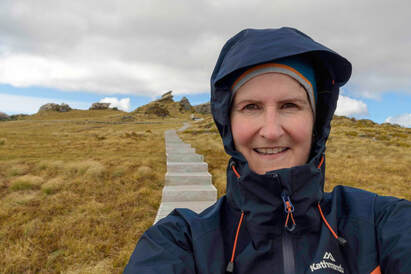
Q: Do you mind just introducing yourself, who you are, where you're from, and a little bit about your background in hiking? My name's Nicola and I'm from Hamilton, in the North Island of New Zealand. Both my mum and my dad are very keen trampers, very keen on the outdoors, and I grew up in the central plateau region of New Zealand, where the first national park in New Zealand is. They both worked for what is now the Department of Conservation, and my dad was quite instrumental in building huts and tracks around the Tongariro National Park area. So having both parents involved in hiking, me and my sister kind of got dragged up hills, uphill and down dale, with both of our parents. I don't know that I particularly liked it during the younger years and the teen years, but it was a little bit later, during my mid-twenties, that I actually found I enjoyed it. Now I just love being outdoors and love all the places you can go, what you can see, what you can do. Q: What are some of the hikes you've done in the past? I've done a couple of the Great Walks here in New Zealand, parts around Lake Waikaremoana, the tracks in the Tongariro National Park, the Heaphy Track, the Kepler, the Routeburn. And then in my own backyard, we've got the Kaimai Range and Mount Pirongia nearby, which I often use as training tools as well as just being nice to be outside. Over the last seven or so years I've really enjoyed getting out above the bush line, even though I don't really have any above-bush-line hikes in the immediate vicinity of where I live. Those are the ones I've tended to aim for. Once or twice a year I aim to do a multi-day walk, often somewhere above the bush line, and the views, being able to see mountain after mountain, hill after hill, are just incredible. Q: When we first started working together, you were leading into a tramp on the Hump Ridge Track. What was the inspiration behind getting involved in that particular track? It's actually my mother who wanted to do it. She's now 72, and the tramping she's been doing recently is more where you take a day pack or use a pack service, trying to carry less weight. I was very conscious of that and thinking I'd really like to do one decent tramp with my mum before she can't carry a full pack anymore. So I suggested we go away that Christmas, since she lives in Australia and comes over to New Zealand every year for it. I gave her the opportunity to choose where she'd like to go. There were two tramps we were looking at, the Banks Peninsula walk and the Hump Ridge, and Mum had heard good things about the Hump Ridge Track, so that's where we ended up going. Q: For those who might not have heard of the Hump Ridge Track before, roughly how many days does it take and how long is the actual distance? The track is three days, a set distance, and the huts need to be booked in advance. It's 62 kilometres, so just over 20 kilometres each day for the three days. Q: Do you want to talk us through your training process leading up to the trip, both initially and once we started training together? We knew probably about August that we were going to be doing this trip. I'd been skiing up until October so I figured that would be enough fitness, and during October I was only doing one big walk a week, not even really a big walk, only about an hour, maybe an hour and a half, but uphill and out in the mountains. Then I contacted you and got on board. I started out doing very small walks, two hours on the weekend, increasing by about half an hour each weekend. Alongside that I was doing strength training and additional cardio work, either on the cross trainer, the indoor bike, or the treadmill, and incrementally increasing the hiking each weekend. Q: Was there anything in the training process that was unfamiliar to you, or surprisingly effective in a way you hadn't expected? Yes. I had a hip injury, an outer hip problem, and my physio told me I wasn't allowed to walk for any significant distance. It was fine to walk around the block, but he wanted me to stop hiking. With that in mind we used the cross trainer, the indoor bike, and I started swimming, which I hadn't done in 30 years since I was at school. It was quite unnerving, because in the past I'd always used the weekend hikes as my measure of how fit I was getting, incrementally adding time and being aware I was approaching the time I expected to be on the trail. Not being able to use those hikes as a measure was actually quite unsettling. So I used a mixture of the cross trainer, the indoor bike, and swimming to maintain cardio fitness, none of which I would normally have used. I would typically have used a treadmill, gone running, or just been out hiking to build that fitness. Q: Did we keep that approach all the way to the end, or did you start hiking again before the trip? It was only about two weeks prior to my walk that I actually got out into the hills and did a couple of small walks, only about an hour and a half. So yes, I maintained the swimming, cross trainer, and indoor bike right up until the end. Q: In those final weeks, once you got back into a little bit of walking with the big trek looming, how were you feeling mentally and physically? The couple of walks I did before the trip felt fine, but I was conscious they were only an hour and a half, so I was still a little nervous about how I would go. There were also things I'd picked up from your podcast that helped, like getting hiking poles, training, and magnesium oil. There were little tips along the way that just gave me those tools in my arsenal. I thought, if I'm adding in all these tools, and I've done all the fitness and the cardio despite not being out walking for any serious length of time, I had some level of comfort knowing you knew what you were talking about and that we had those tools in place. Q: Do you want to talk me through the specifics of the actual trip and any particular challenges that came up while you were on the trail? It's a stunning, stunning walk. The Hump Ridge Track is in the south-west of the South Island. It starts through bush and then heads out onto a beach, follows the beach for quite some way, and then heads up to limestone tors and outcrops. It's absolutely stunning up there, above the bush line, where you can see what feels like forever around the coastline, with beautiful lakes and hills inland. It's a little bit different from what I'm used to. Our backcountry huts in New Zealand usually don't sell anything, but on this trip the huts sell food, and you can even hire a sleeping bag if you don't want to carry all your own equipment, so you can take things a little easier on this particular tramp. The first day is along the beach and then up to almost 1,000 metres. They say between seven and nine hours for the first and second day, and I found it took me roughly seven hours, at the lower end of what they suggest. My mum beat me every day. Despite being 25 years older than me, she made it to each hut a good half hour, if not more, faster than I did. It's incredible how fit she is. The second day goes from above the bush line, down through the bush, and along a series of old tram tracks to what used to be a sawmilling village in the early 1900s. It's quite an interesting spot, with sawmilling relics, the remains of the old wharf, boiler houses, machinery, and so forth. The second day was mostly downhill, and there's a lot of boardwalk on this track, roughly 12 kilometres, there to protect some of the fragile alpine areas. It is a bit tough on your feet, and I think that's probably the one thing I found, because I wasn't walking properly in preparation for the trip. My feet probably weren't as conditioned as they would have been otherwise. I ended up with two black toenails, which I still have, and they were quite painful, though fortunately I didn't really feel them until the last day, maybe the last two hours. I also ended up with some blisters on my heels that I didn't notice until those last couple of hours either. So the real challenge was more after the trek than while I was actually on it. Q: With blisters, given your hiking experience, what's your go-to tip for dealing with them? This one was quite difficult. It wasn't a surface blister I could prick and let drain. It was really deep on the sole of my foot, so there wasn't much I could do at all. If it had been a surface blister, depending on where it was and how much it was troubling me, I might have pricked it with a sterile needle and covered it with a plaster. But in this case it was too deep, so it was just grin and bear it for the last three or so kilometres. I was walking very gingerly, but it didn't matter, it was the end, so I could take my time. Q: Looking back over the whole process, from the first inspiration to stepping off the trail, were there any particular lessons you've taken into your future hiking? The thing I mentioned around not being able to hike in the lead-up and using other methods of cardio fitness, like swimming, was quite a challenge, and it really came down to trusting you at the time, which I'm really glad I did. I'm glad I had you there to talk things through and get those tips and tricks, someone who could be a voice of reason. The big lesson for me was that yes, I can get fit without resorting to hiking every weekend or walking distances during the week. I was swimming twice a week, cycling once a week, and on the cross trainer once a week, so three or four cardio sessions packed into the week. Trusting that I was actually getting fitter, that I was doing good, that I was advancing and progressing, was the biggest lesson. Q: Would there be anything you'd do differently next time, whether in your training or on the trail? Everything worked out really well on the trail. I was really pleased with everything that worked, from the hiking poles, the magnesium oil, taking my tennis ball to release the muscles around my buttocks and my hip. That all worked really well. The only thing I probably would have done differently is given more time to the lead-up. I only started training about two months prior to the trip, and if I'd had a third month, that probably would have given me a bit more peace of mind around how I was doing physically. Q: What would you say was the low light of the trip, and what was the highlight? I think the low light was coming off the track with the blisters and toenails, both Mum and I had sore feet by the end. But it's not much of a low light compared to the highlight of the trip, which was the stunning scenery at the very top of the track, where the limestone tors are. These amazing limestone rock formations with little tarns or lakes up there reflecting the views, it was just stunning. I'd encourage anyone to go and have a look at photos of the Hump Ridge Track and the limestone tors, they're just stunning, and the coastal views are incredible. Q: What's the next adventure? I'm hoping to do the Travers-Sabine Valleys, at the top of the South Island in New Zealand. It's roughly a six-day track, I'm not sure exactly how many kilometres, but it's something I've looked at for a couple of years. There are some pretty long days in there too, I think some are seven to nine hours, but again stunning scenery and a lot of above-the-bush-line walking, which I'm really looking forward to. Q: For listeners who might find themselves two months or six weeks out from a trip, experiencing pain or discomfort and being told by a physio to back off their walking, what words of advice can you give them? There's still plenty you can do. You'll want to take your physio's advice, and they'll probably give you some exercises, but I think the key thing is asking them what you can do. They might tell you what you're not allowed to do, but ask what you can work on. For me, with my hip, it was about unloading my hip, doing any exercise that didn't put load or weight through it. So I'd be asking that question directly, and letting them know you've got a trip coming up, because they'll take that into account and try to keep you moving and in the best condition leading into it.
|
AuthorRowan is an online personal trainer who specialises in training for hiking and mountaineering. He helps get them fit, strong and resilient so they can conquer every adventure. Archives
July 2026
Categories
All
|
AboutSummit Strength is a personal training for hiking service created specifically to help hikers have the best chance of a safe, enjoyable and successful adventure.

|
Company |
Services |
Support |
|
© COPYRIGHT 2018. ALL RIGHTS RESERVED.
|
Website Design by My Personal Trainer Website
|

RSS Feed